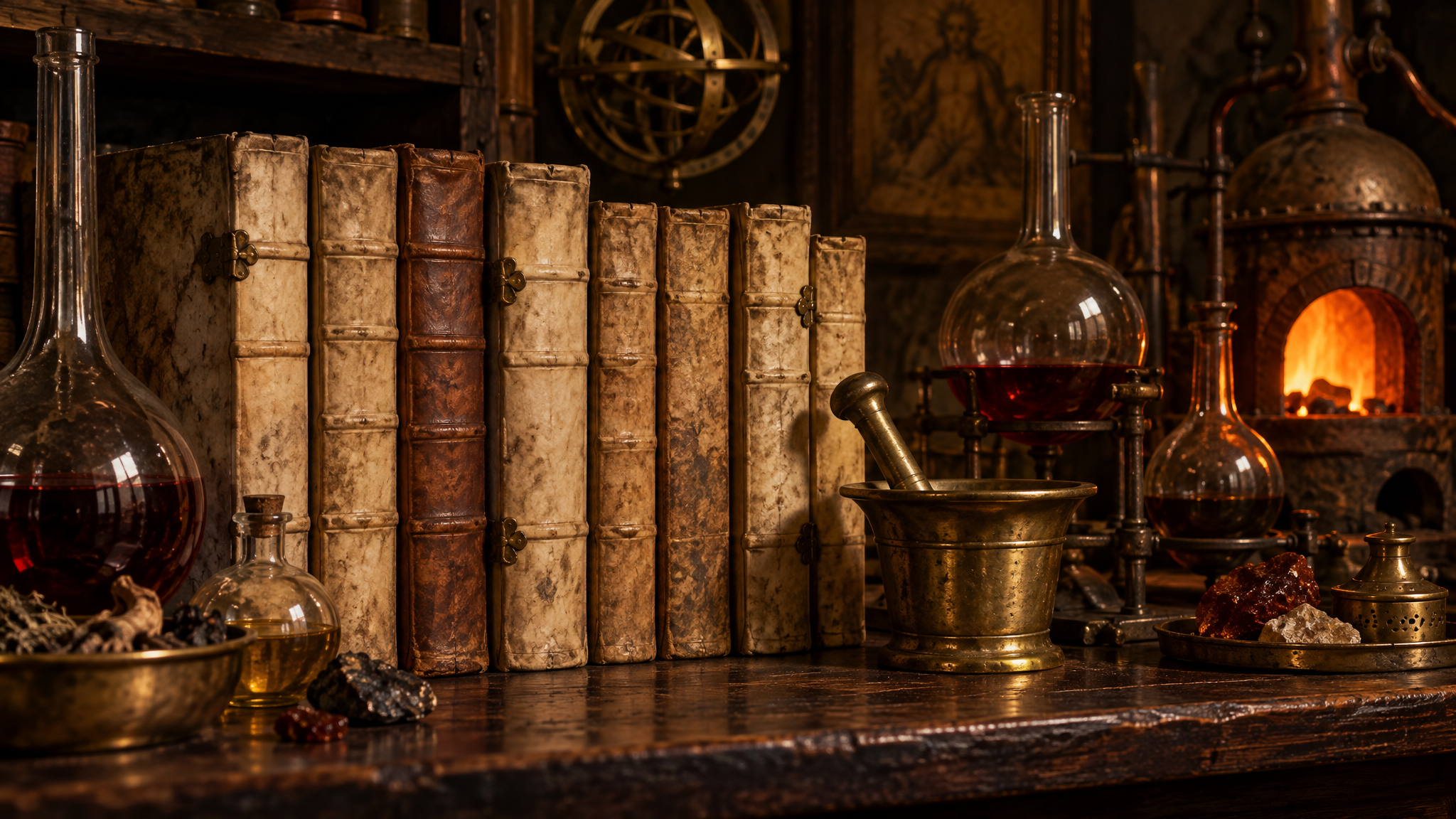
Classics of Alchemy
The laboratory and the oratory: texts of the Great Work.
Alchemy was at once a practical chemistry, a philosophy of nature and a symbolic language for spiritual transformation. Its texts are deliberately obscure, written in images, riddles and allegories that assume a patient reader.
This workshop gathers the canonical authors, Paracelsus, Basil Valentine and Michael Maier, beside the great anthologies such as the Hermetic Museum, and the later interpretive studies that read alchemy as inner work. Start with the anthologies; they show how alchemists read one another.
Alchemical texts were written to conceal as much as to reveal, using animals, kings and planets as names for substances and processes. Read with patience, and use the emblem books and later dictionaries as keys. A useful order is to start with the collected tracts of the Hermetic Museum, move to individual authors such as Basil Valentine and Paracelsus, and only then approach the most allegorical works. The shelf covers both practical chemistry and spiritual interpretation; noticing which a given author is doing, or whether he makes any distinction, is part of the pleasure of the reading.
On This Shelf (25)
Splendor Solis: Alchemical Treatises of Solomon Trismosin
Salomon Trismosin
The Turba Philosophorum, or Assembly of the Sages, called also The Book of Truth in the Art and the Third Pythagorical Synod: An Ancient Alchemical Treatise translated from the Latin, the chief readings of the shorter codex, parallels from the Greek alchemists, and explanations of obscure terms
Arthur Edward Waite
English · Alchemy
Alchemiae Gebri Arabis philosophi solertissimi Libri
Rogerus Bacon; Hermes Trismegistus; Geber Latinus; Kalid Ben-Jazichi; Richardus Anglicus; Hortulanus
Alchemiae Gebri Arabis philosophi solertissimi Libri
Rogerus Bacon; Hermes Trismegistus; Geber Latinus; Kalid Ben-Jazichi; Richardus Anglicus; Hortulanus
Latin · Alchemy
De Alchemia Dialogi II
Geber Latinus; Raimundus Lullus; Giovanni Bracesco
Marcianus graecus Z. 299 (=584) — Corpus of the Greek Alchemists
Zosimos of Panopolis, Stephanus of Alexandria, ps.-Democritus, et al.
Marcianus graecus Z. 299 (=584) — Corpus of the Greek Alchemists
Zosimos of Panopolis, Stephanus of Alexandria, ps.-Democritus, et al.
Greek · Alchemy
Jo. Jacobi Mangeti ... Bibliotheca chemica curiosa, seu rerum ad alchemiam pertinentium thesaurus instructissimus: quo non tantum artis auriferae ... verum etiam tractatus omnes virorum ... ad quorum omnium illustrationem additae sunt quamplurimae figurae aeneae. Tomus primus [-secundus] / Tomus primus.
Manget, Jean-Jacques (1652-1742)
Latin · Alchemy
Lives of Alchemystical Philosophers, Based on Materials collected in 1815 and Supplemented by Recent Researches, with a Philosophical Demonstration of the True Principles of the Magnum Opus, or Great Work of Alchemical Re-construction, and some Account of the Spiritual Chemistry; to which is added a Bibliography of Alchemy and Hermetic Philosophy
Arthur Edward Waite
1815 · English · Alchemy