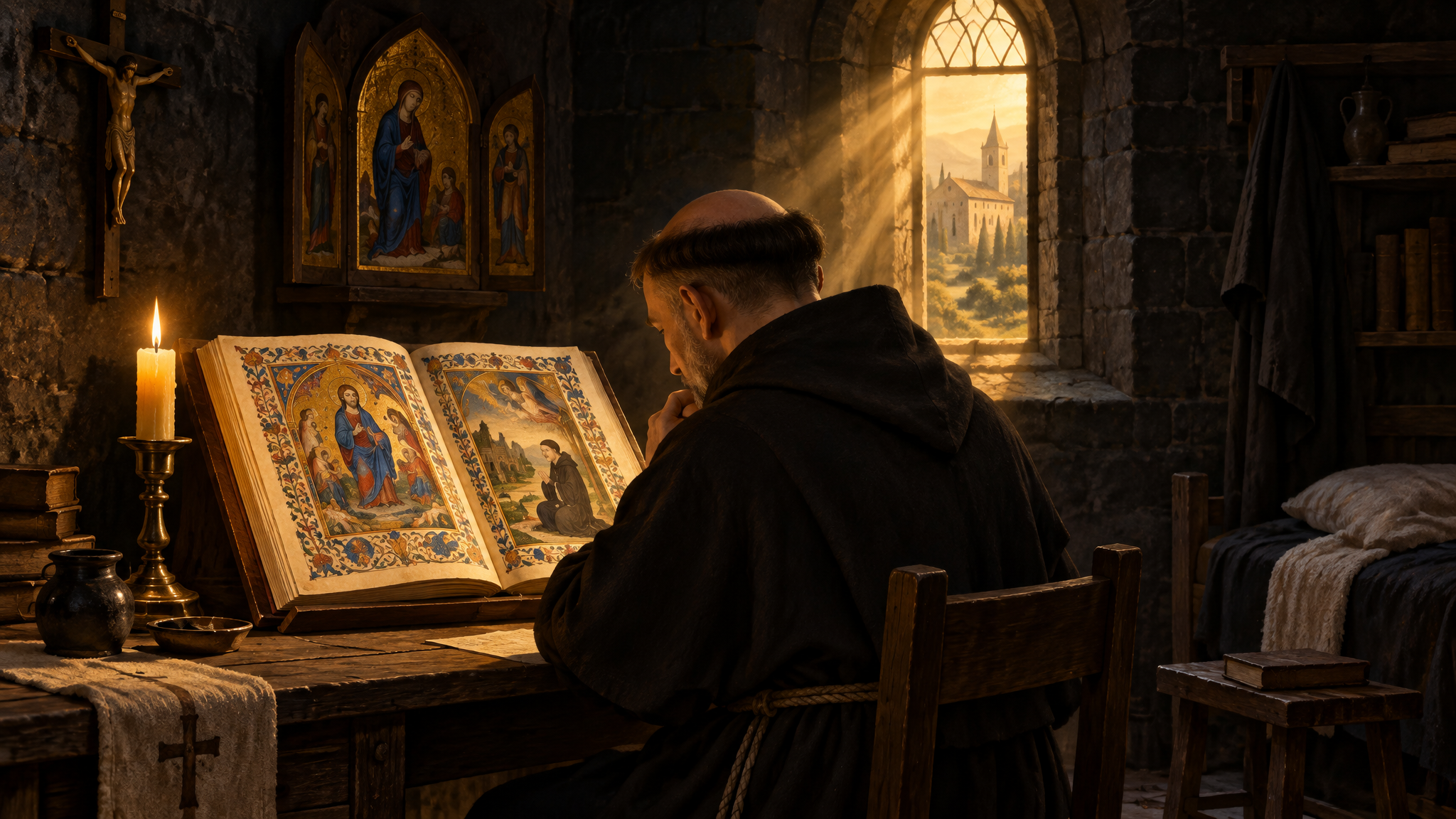
Christian Mysticism
The contemplative current inside Christianity, from the desert to Görlitz.
Christian mysticism is the long tradition of seeking direct, experiential union with God within the Christian framework. It runs from the desert fathers through medieval monasteries and Carmelite reformers to the Protestant visionary Jacob Boehme.
This guide concentrates on the classic texts in the archive and suggests a sequence that moves from practical devotion to speculative theosophy.
What It Is
Two broad ways run through the tradition. The apophatic way, rooted in Dionysius, approaches God by negation, entering a “cloud of unknowing” beyond concepts. The affective way stresses love, imitation of Christ and the stages of prayer mapped by Teresa of Ávila and John of the Cross.
From the seventeenth century, Boehme and later Swedenborg opened a more speculative, visionary line that fed directly into Western esotericism.
Why It Matters
Much of the vocabulary of modern spirituality, the dark night, interior castles, mystical union, comes from these writers. Read in their own terms they are rigorous, orthodox and often startlingly psychological.
Core Texts
Contemplative classics from Dionysius to Boehme and Swedenborg.
The Works of Dionysius the Areopagite
Pseudo-Dionysius the Areopagite
The Adornment of the Spiritual Marriage
Jan van Ruysbroeck
Angelic Wisdom about Divine Providence
Emanuel Swedenborg
A Beginner’s Sequence
Everyday devotion
The Imitation of Christ is short chapters of practical counsel; the most-read Christian book after the Bible for centuries.
The apophatic way
An anonymous fourteenth-century English guide to contemplative prayer beyond images and thoughts.
The source of negative theology
Dionysius’s Mystical Theology is only a few pages long; read it after the Cloud to see where its ideas came from.
The Works of Dionysius the Areopagite
Pseudo-Dionysius the Areopagite
The Carmelite maps
Teresa’s mansions of the soul and John’s dark night chart the stages of prayer with unusual precision.
Visionary theosophy
Boehme’s dense symbolic cosmology, the bridge from Christian mysticism to later esotericism.