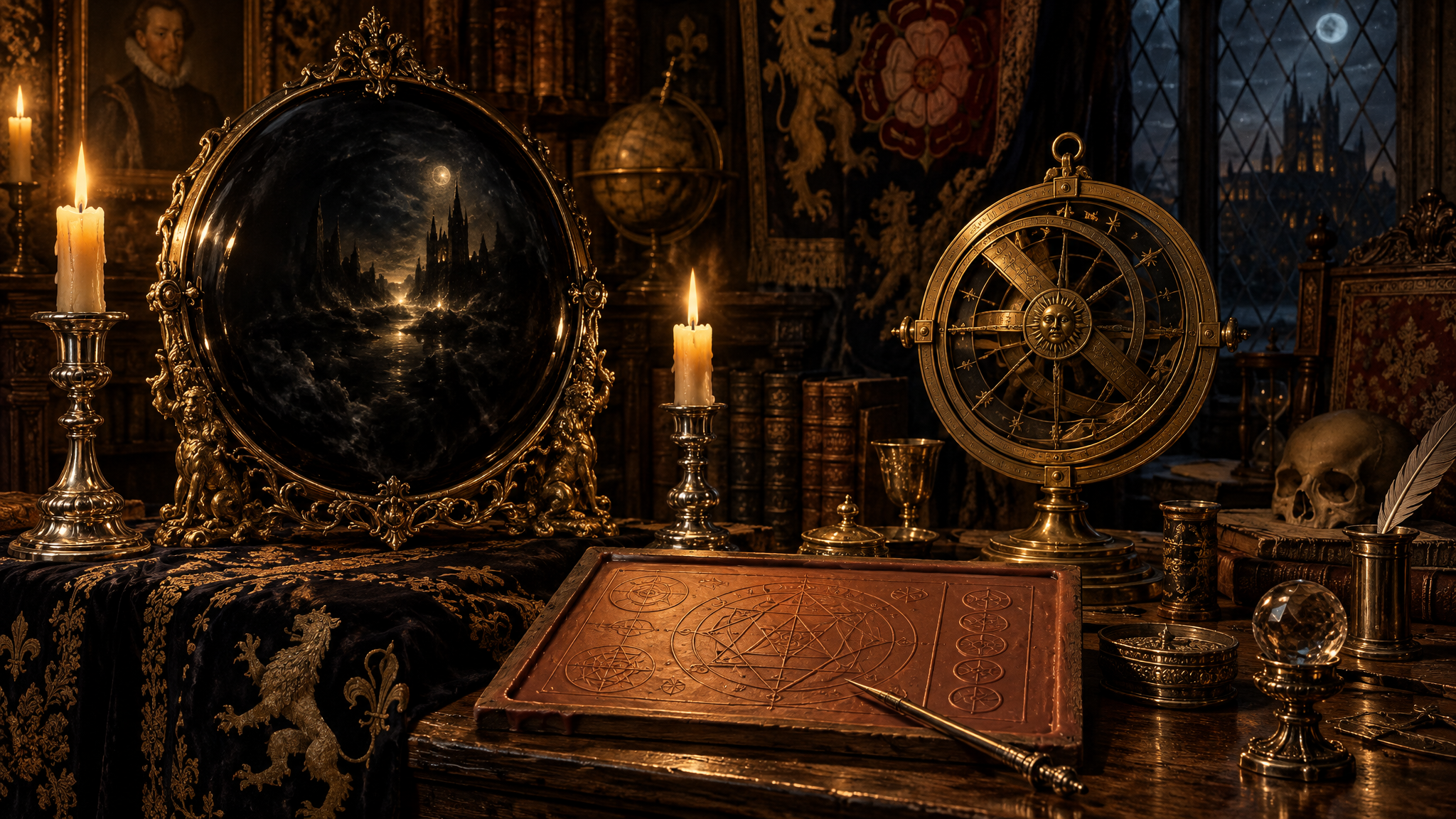
John Dee and Enochian Magic
An Elizabethan mathematician, a scryer, and the language of angels.
John Dee (1527–1608/9) was mathematician, geographer and adviser to Elizabeth I. In the 1580s, working with the scryer Edward Kelley, he recorded conversations with angels who dictated a language, a set of calls and elaborate tables: the system later called Enochian.
This guide separates Dee’s own writings from the later occult reconstructions built on them.
What It Is
Dee’s Monas Hieroglyphica (1564) presents a single glyph as the key to cosmic unity. His spirit diaries, the Five Books of Mysteries and related manuscripts, preserve the angelic sessions, the Liber Loagaeth and the forty-eight Calls.
Three centuries later the Golden Dawn and Crowley reorganised this material into a working magical system.
Why It Matters
Dee sits at the crossroads of Renaissance science and magic, and the Enochian material is one of the most influential bodies of revealed text in modern occultism. Knowing which layer you are reading prevents a lot of confusion.
Core Texts
Dee’s own works, the angelic manuscripts, and later Enochian reconstructions. The shelf is still small.
A Beginner’s Sequence
The man
A biography placing Dee in his Elizabethan world before the angels appear.
Dee’s philosophy
The Monas Hieroglyphica, his own compressed statement of cosmic unity through a single symbol.
The angelic diaries
The Five Books of Mysteries record the first sessions with Kelley. Read them as historical documents.
The language
The Calls and the angelic alphabet, the material the later magicians used most.
The modern system
Crowley’s Liber Chanokh shows how the Golden Dawn tradition turned Dee’s records into ritual.