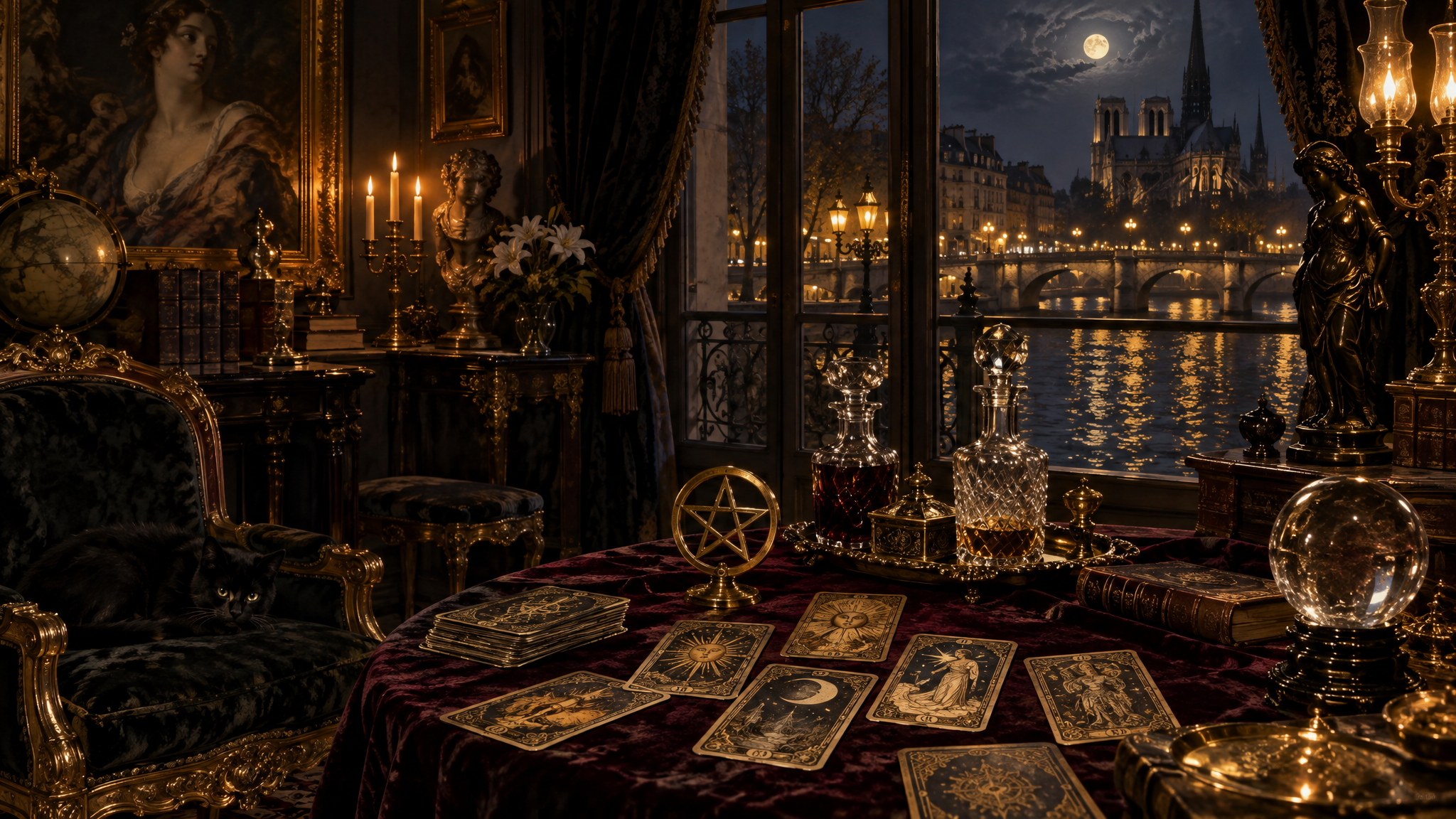
The French Occult Revival
From Martinist theosophy to the Parisian magicians of the fin de siècle.
Modern ceremonial magic was largely invented in France. Éliphas Lévi’s Dogme et Rituel (1854–56) fused Kabbalah, tarot and magnetism into a single “science” of magic, and his successors in fin-de-siècle Paris built orders, journals and textbooks on it.
This guide traces that revival from its Martinist prehistory to Papus, its great systematiser.
What It Is
Louis-Claude de Saint-Martin, the “Unknown Philosopher”, gave France a Christian theosophy of reintegration. Lévi transformed occultism into a romantic philosophy of the astral light. Papus, Guaita and Péladan organised it into the Martinist Order and Kabbalistic Rose-Croix.
Why It Matters
The Golden Dawn read Lévi closely, and his attribution of the tarot trumps to the Hebrew letters became standard. Understanding the French revival explains much of English-language occultism.
Core Texts
Lévi in Waite’s translations and in French, Papus, and the Martinist sources.
Theosophic Correspondence (with Kirchberger)
Louis-Claude de Saint-Martin
A Beginner’s Sequence
The Martinist prelude
Saint-Martin’s letters and Waite’s study introduce the Christian theosophy that preceded the magicians.
Theosophic Correspondence (with Kirchberger)
Louis-Claude de Saint-Martin
Lévi’s synthesis
The Doctrine and Ritual of Transcendental Magic, the book that launched the modern occult revival.
Lévi’s last word
Le Grand Arcane, his final and most reflective statement, in French.
The tarot system
Papus’s Tarot of the Bohemians, the French Kabbalistic tarot in full.
The systematiser
Papus’s methodical treatise on occult science and his study of Kabbalah, in French.