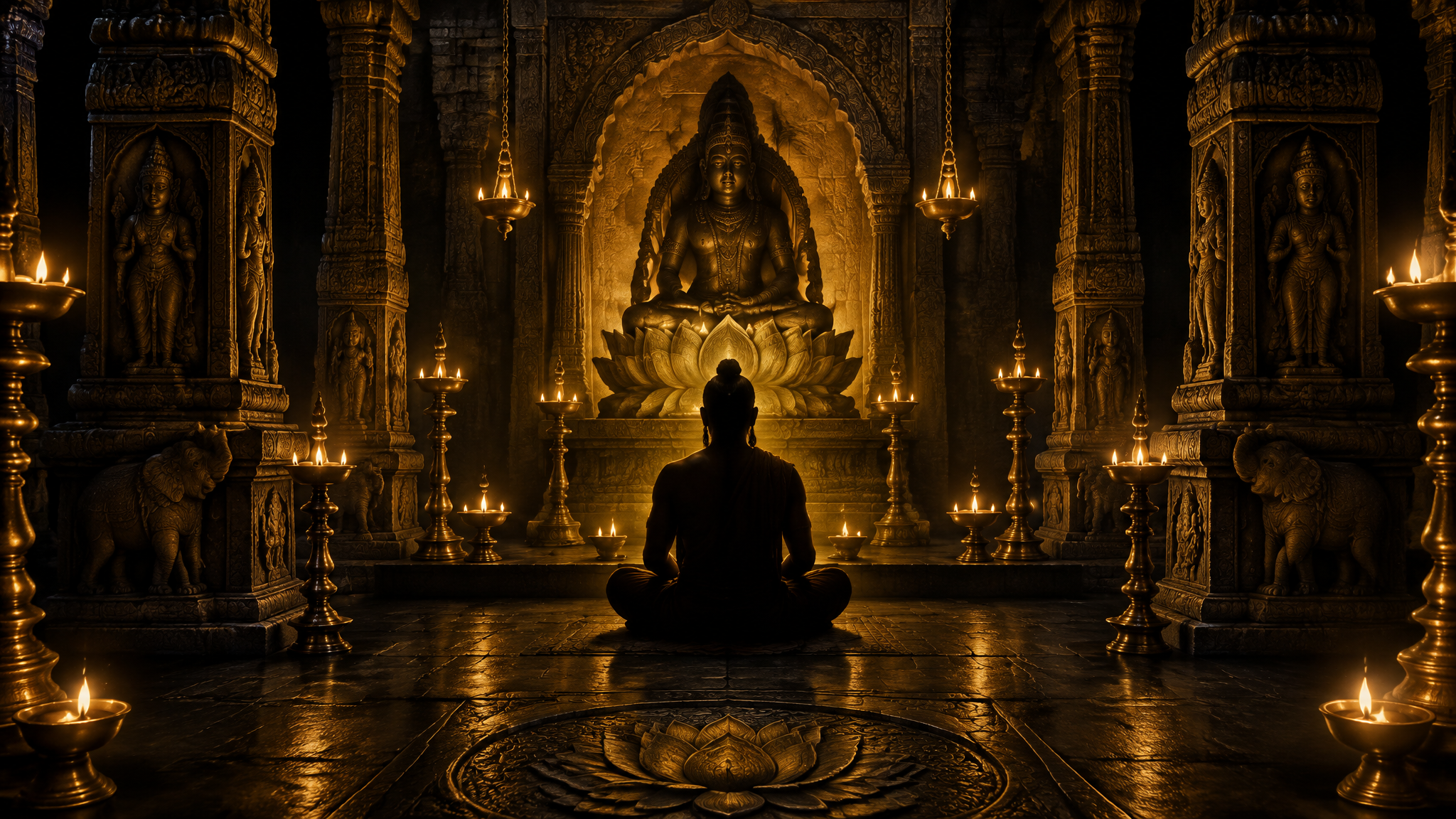
Yoga and Tantra
Disciplines of mind and body, older and stranger than the gym mat.
Yoga, in its classical sense, is a discipline for stilling the mind and liberating the self. Tantra is a vast family of Hindu and Buddhist traditions that treat the body, ritual, mantra and energy as vehicles of liberation.
The archive holds both Sanskrit editions and the early English presentations that introduced these traditions to Western esotericists.
What It Is
Patanjali’s Yoga Sutras define yoga as the cessation of the fluctuations of the mind and set out eight limbs, from ethics and posture to meditative absorption. The Yoga Vasistha frames liberation as awakening from the dream of the world.
Tantric traditions add elaborate maps of subtle channels and centres, deity visualisation and initiation, often guarded as secret teachings.
Why It Matters
Theosophists, the Golden Dawn and modern occultists borrowed heavily from yoga and tantra, often loosely. Going back to the sources clarifies what was received, what was invented and what was lost.
Core Texts
Classical yoga texts in Sanskrit and English, early Western presentations, and a modern study of tantra.
Yoga Sutra Vritti of Bhoja (Pothi or Manuscript)
Ajit Gargeshwari
The Yoga-Vasistha of Valmiki with Vasistha Maharamayana-Tatparya Prakasa in Sanskrit - Edited By Wasudev Laxman Shastri Pansikar
Wasudev Laxman Shastri Pansikar
The Yoga-Vasistha of Valmiki with Vasistha Maharamayana-Tatparya Prakasa in Sanskrit - Edited By Wasudev Laxman Shastri Pansikar
Wasudev Laxman Shastri Pansikar
Sanskrit · Yoga & Tantra
A Beginner’s Sequence
A Western primer
Ramacharaka’s early twentieth-century lessons popularised Raja Yoga in the West. Accessible, but a presentation, not a source.
The classical source
Patanjali’s Yoga Sutras with commentary: the foundation of classical yoga philosophy.
The philosophy of awakening
The Yoga Vasistha, a vast dialogue on the illusory nature of the world. Dip in rather than read straight through.
The Yoga-Vasistha of Valmiki with Vasistha Maharamayana-Tatparya Prakasa in Sanskrit - Edited By Wasudev Laxman Shastri Pansikar
Wasudev Laxman Shastri Pansikar
The Yoga-Vasistha of Valmiki with Vasistha Maharamayana-Tatparya Prakasa in Sanskrit - Edited By Wasudev Laxman Shastri Pansikar
Wasudev Laxman Shastri Pansikar
Sanskrit · Yoga & Tantra
Tantra
A modern practitioner’s study of tantric ideas, useful as orientation before older and more technical material.